Last updated:
Trametes Versicolor
"Turkey Tail"
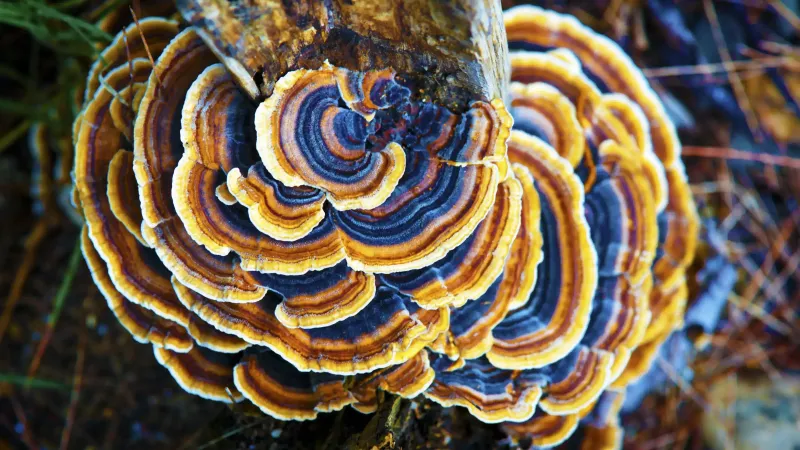
Trametes Versicolor fruiting bodies
Scientific Classification
Kingdom:Fungi
Division:Basidiomycota
Class:Agaricomycetes
Order:Polyporales
Family:Polyporaceae
Genus:Trametes
Frequently Asked Questions
- What is Turkey Tail?
- Turkey Tail (Trametes Versicolor) is a mushroom species, belonging to the Polyporaceae family. It is studied for its biological characteristics and is documented in the ShroomSpy mycology database.
- Is Turkey Tail edible?
- inedible
- What effects does Turkey Tail produce?
- Turkey Tail is associated with the following effects: Energy. Individual experiences vary based on dose, set, and setting.
- What is the scientific classification of Turkey Tail?
- Turkey Tail belongs to the kingdom Fungi, division Basidiomycota, class Agaricomycetes, order Polyporales, family Polyporaceae, genus Trametes. Its scientific name is Trametes Versicolor.
About
Trametes versicolor, commonly known as Turkey Tail Mushroom, is a well-known polypore fungus that grows on dead or decaying hardwood. Named for its multicolored, fan-like appearance that resembles the tail feathers of a wild turkey, this mushroom is one of the most extensively studied medicinal fungi. It is globally recognized for its immune-modulating properties and is widely used in integrative and functional medicine, particularly in cancer support protocols.
History
The use of Turkey Tail in traditional medicine dates back thousands of years, particularly in Chinese and Japanese healing systems where it is known as Yun Zhi. Historically valued for longevity and vitality, it gained scientific prominence in the late 20th century when researchers in Japan developed the PSK (Polysaccharide-K) extract, now used as an adjunct treatment in cancer therapy.
Western interest in T. versicolor has since expanded, with multiple clinical trials exploring its antiviral, antioxidant, and immunotherapeutic properties. Its ability to stimulate immune cells—especially natural killer cells and T-cells—has made it a staple in holistic and alternative health circles.
Overview
Trametes versicolor is a saprotrophic fungus that forms thin, wavy, overlapping brackets on logs, stumps, and branches. It thrives in a wide variety of climates and is found in forests across Asia, Europe, and the Americas. Its cap features concentric zones of different colors—usually brown, gray, white, blue, or orange—making it both visually stunning and easy to recognize.
While not edible in its raw form due to its tough texture, it is typically consumed as a tea, tincture, or capsule extract. It contains potent polysaccharopeptides like PSK and PSP, which support immune function, aid in gut health, and may help reduce tumor growth. As one of the most accessible and thoroughly researched medicinal mushrooms, Turkey Tail continues to bridge the gap between traditional herbal wisdom and modern biomedical science.
Physical Characteristics
Caps:
Flat, circular, multicolored
Gills:
No gills, has pores
Choosing the Right Products
• Fruiting Body + Mycelium:
Look for products that contain both fruiting body and mycelium.
• Avoid Mycelium Grown on Rice:
These products often contain significant amounts of starch and fewer beta glucans.
• Tincture products may be slightly inferior:
Specifically for immunological, anticancer, and antiviral effects due to the active beta-glucan content not being alcohol soluble. If tincture is the preferred supplement, make sure it is double extracted with hot water and alcohol.
Cognitive Effects
Energy
Turkey tail appears to boost energy levels through its adaptogenic properties. They help the body adapt to stress and maintain balance. Chronic stress can deplete energy reserves, but adaptogens like turkey tail can help mitigate the negative effects of stress, leading to improved energy levels.
Pharmacology
Helps With
Immune System
Improves immune function and fights infections. High Beta Glucan content leads to interactions with our body's immune sensors, such as toll-like receptors, in the small intestine. These lead to a complex immune response that leads to cancer and tumor cell suppression and greater surveillance and antibody production.
Cancer
Has potential anti-cancer properties.
Turkey Tail Products
Explore Turkey Tail products from independent vendors
Chemical Constituents
Medicinal Chemistry
Similar Species
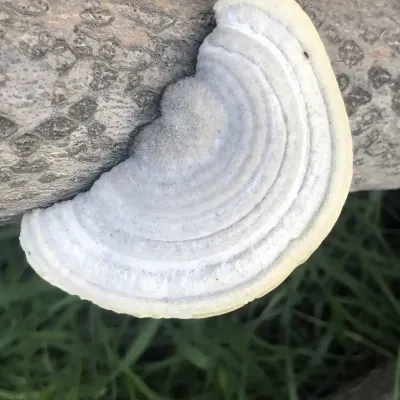
Species: Trametes hirsuta
(Hairy Bracket)
Edibility: non-edible - while not toxic, it is tough and not suitable for consumption.
Key Differences: Trametes hirsuta has a more hairy and rough cap surface compared to the smoother surface of Trametes versicolor.
Species: Trametes hirsuta
(Hairy Bracket)
Edibility: non-edible - while not toxic, it is tough and not suitable for consumption.
Key Differences: Trametes hirsuta has a more hairy and rough cap surface compared to the smoother surface of Trametes versicolor.
Mushroom Ratings
4.0
(1)
Based on 1 Review
5
★4
★3
★2
★1
★Share your thoughts
If you've consumed this mushroom, share your thoughts with our community
01/30/2025
Noah Schlickeisen
EnergyFocusContentRelaxed
Started putting Turkey Tail powder in my morning smoothies a while back. Tastes kinda earthy but you get used to it, especially if you blend it with banana or something.
The big thing I noticed? I haven't gotten my usual winter cold this year. Could be coincidence but I'm not complaining. Also my gut feels better - less bloated, more regular if you know what I mean.
No weird side effects for me which was nice. Energy has been pretty steady too. Not saying it's magic but something's working. If you get sick a lot during cold season might be worth adding to your routine
References
- Saxe, G., Shubov, A., Smith, C., Golshan, S., Shekhtman, T., Wilson, S., Slater, D., Bair, Z., Beathard, C., Davis, R., MacElhern, L., Kao, L., Senowitz, P., Gosnell, N., Buchholz, D., & Aguilar-Carreno, H. (2026). Polypore Mushroom Mycelia for Treatment of Active COVID-19 Infection: A Randomized Clinical Trial. . https://doi.org/10.64898/2026.06.01.26354267
- Łysakowska, P. & Sobota, A. (2023). Medicinal Mushrooms: Their Bioactive Components, Nutritional Value and Application in Functional Food Production—A Review. Molecules.
- Ameri, A. (2023). Removal of dyes by Trametes versicolor laccase immobilized on NaY-zeolite. .
- Kabploy, K. (2023). Development of an antimicrobial fungal egg tray containing orange oil and smoke for eggs preservation at room temperature. .
- Sciacca, C. (2023). 2,3-Bis((E)-4-hydroxybenzylidene)-N1,N4-bis(4-methylbenzyl)succinamide. .
- Castiblanco, T. (2020). Trametes genus, a source of chemical compounds with anticancer activity in human osteosarcoma: A systematic review. .
- Benson, K. (2019). The mycelium of the Trametes versicolor (Turkey tail) mushroom and its fermented substrate each show potent and complementary immune activating properties in vitro. .
- Duvnjak, D. (2016). Advances in batch culture fermented Coriolus versicolor medicinal mushroom for the production of antibacterial compounds. .
- Quayle, K. (2014 ). The TLR2 agonist in polysaccharide-K is a structurally distinct lipid which acts synergistically with the protein-bound β-glucan. .
- Pallav, K. (2014). Effects of Polysaccharopeptide from Trametes versicolor and amoxicillin on the gut microbiome of healthy volunteers. .