Last updated:
Pleurotus Eryngii
"King Oyster, King Trumpet, French Horn"
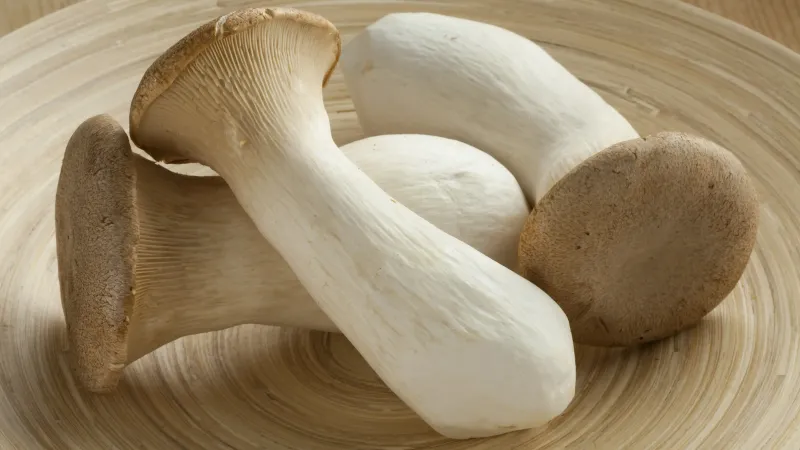
Pleurotus Eryngii fruiting bodies
Scientific Classification
Kingdom:Fungi
Division:Basidiomycota
Class:Agaricomycetes
Order:Agaricales
Family:Pleurotaceae
Genus:Pleurotus
Frequently Asked Questions
- What is King Oyster?
- King Oyster (Pleurotus Eryngii) is a mushroom species, belonging to the Pleurotaceae family. It is studied for its biological characteristics and is documented in the ShroomSpy mycology database.
- Is King Oyster edible?
- edible
- What is the scientific classification of King Oyster?
- King Oyster belongs to the kingdom Fungi, division Basidiomycota, class Agaricomycetes, order Agaricales, family Pleurotaceae, genus Pleurotus. Its scientific name is Pleurotus Eryngii.
About
Pleurotus eryngii, commonly known as the King Oyster Mushroom, King Trumpet, or Eryngii, is the largest species in the Pleurotus genus. Renowned for its thick, meaty stem and small cap, this gourmet mushroom is cultivated worldwide and prized in Asian and European cuisine for its umami flavor and exceptional texture, often compared to abalone or scallops when cooked.
History
Native to the Mediterranean, Middle East, and parts of Asia, King Oyster mushrooms have been used in traditional cooking and cultivated for centuries. They became commercially important in the late 20th century due to their long shelf life, ease of cultivation, and versatility in vegetarian and vegan dishes.
Although not historically prominent in traditional medicine, modern studies show that P. eryngii has antioxidant, cholesterol-lowering, and immune-enhancing properties, making it a valuable functional food.
Overview
The mushroom has a thick, cylindrical stem and a small, tan to brown cap. It grows naturally on the roots of herbaceous plants like Eryngium, but is commonly cultivated on substrates like sawdust or grain. Unlike other oysters, its stem is fully edible and desirable.
It has a dense, chewy texture and mild nutty flavor that intensifies when roasted, grilled, or pan-seared. It is often used in stir-fries, sliced into steaks, or braised. Nutritionally, it is rich in protein, B vitamins, potassium, and ergothioneine, an antioxidant linked to cellular protection.
Flavors
Mild
Mild flavor with a slight sweetness
Textures
Firm
Firm texture when cooked, similar to abalone
Fragrances
Gentle
Mild aroma, not particularly distinctive
Physical Characteristics
Caps:
Tan to brown, smooth, convex to flat
Gills:
White, decurrent
Pharmacology
Helps With
Heart Health
May help to improve heart health.
Diabetes
May help to improve blood sugar control.
Digestion
May help to improve digestion.
King Oyster Products
Explore King Oyster products from independent vendors
Chemical Constituents
Medicinal Chemistry
Similar Species
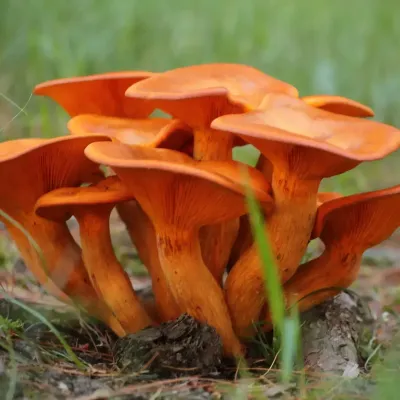
Species: Omphalotus olearius
(Jack-o'-lantern mushroom)
Edibility: Poisonous — do not eat. The jack-o'-lantern is not deadly, but it is a violent gastrointestinal irritant. Ingestion causes severe nausea, vomiting, abdominal cramping, diarrhea, and sweating, typically beginning within 15 minutes to a few hours and lasting up to about 24 hours; severe cases may require supportive hospital care. It is one of the most common causes of mushroom poisoning because it is mistaken for edible chanterelles — unlike chanterelles (which grow singly with blunt, forked, ridge-like false gills), the jack-o'-lantern grows in dense clusters on or near wood and has true thin, sharp, decurrent gills.
Key Differences: the Jack O'Lantern mushroom has a bright orange color, compared to the white to tan color of the King Oyster mushroom. Furthermore, the gills of the Jack O'Lantern mushroom are bioluminescent and can glow in the dark, a feature not present in the King Oyster mushroom. It's crucial to note that while the King Oyster mushroom is edible and highly prized, the Jack O'Lantern mushroom is poisonous and can cause severe gastrointestinal distress if consumed.
Species: Omphalotus olearius
(Jack-o'-lantern mushroom)
Edibility: Poisonous — do not eat. The jack-o'-lantern is not deadly, but it is a violent gastrointestinal irritant. Ingestion causes severe nausea, vomiting, abdominal cramping, diarrhea, and sweating, typically beginning within 15 minutes to a few hours and lasting up to about 24 hours; severe cases may require supportive hospital care. It is one of the most common causes of mushroom poisoning because it is mistaken for edible chanterelles — unlike chanterelles (which grow singly with blunt, forked, ridge-like false gills), the jack-o'-lantern grows in dense clusters on or near wood and has true thin, sharp, decurrent gills.
Key Differences: the Jack O'Lantern mushroom has a bright orange color, compared to the white to tan color of the King Oyster mushroom. Furthermore, the gills of the Jack O'Lantern mushroom are bioluminescent and can glow in the dark, a feature not present in the King Oyster mushroom. It's crucial to note that while the King Oyster mushroom is edible and highly prized, the Jack O'Lantern mushroom is poisonous and can cause severe gastrointestinal distress if consumed.
Nutrition Facts
Serving Size
Amount Per Serving
Calories
% Daily Value*
Total Fat 0.4 g1%
Saturated Fat 0 g0%
Trans Fat 0 g
Cholesterol 0 mg0%
Sodium 18 mg1%
Total Carbohydrate 6.1 g2%
Dietary Fiber 2.3 g8%
Total Sugars 1.1 g
Protein 3.3 g7%
Vitamin A 0 µg 0%•Thiamin B1 0.1 mg 8%
Riboflavin B2 0.3 mg 23%•Niacin B3 5 mg 31%
Vitamin B6 0.1 mg 6%•Folate B9 38 µg 10%
Vitamin B12 0 mg 0%•Vitamin C 0 mg 0%
Vitamin D 29 µg 145%•Vitamin E 0 mg 0%
Vitamin K 0 µg 0%•Calcium 3 mg 0%
Copper 0.2 mg 22%•Iron 1.3 mg 7%
Magnesium 18 mg 4%•Manganese 0.1 mg 4%
Phosphorus 120 mg 10%•Potassium 420 mg 9%
Selenium 2.6 µg 5%•Zinc 0.8 mg 7%
Vit A 0 µg 0%•B1 0.1 mg 8%
B2 0.3 mg 23%•B3 5 mg 31%
B6 0.1 mg 6%•B9 38 µg 10%
B12 0 mg 0%•Vit C 0 mg 0%
Vit D 29 µg 145%•Vit E 0 mg 0%
Vit K 0 µg 0%•Calcium 3 mg 0%
Copper 0.2 mg 22%•Iron 1.3 mg 7%
Mg 18 mg 4%•Mn 0.1 mg 4%
Phosph. 120 mg 10%•Pot. 420 mg 9%
Selenium 2.6 µg 5%•Zinc 0.8 mg 7%
* Percent Daily Values are based on a 2,000 calorie diet.
Mushroom Ratings
0.0
Based on 0 Reviews
5
★4
★3
★2
★1
★Share your thoughts
If you've consumed this mushroom, share your thoughts with our community
References
- Qutaibi, M. A. & Kagne , S. R. (2024). Exploring the Phytochemical Compositions, Antioxidant Activity, and Nutritional Potentials of Edible and Medicinal Mushrooms. .
- Loc, P. (2023). The relationship between mycelial growth and fruit body’s yield of oyster mushrooms (Pleurotus spp.) collected from southern Vietnam. .
- Hassan, A. A. (2023). Isolation, Phenotypic and Molecular Characterization of the Oyster Mushroom Pleurotus spp. and Evaluation of Its Efficacy in Producing the Antibiotic Pleurotin. .
- Dedousi, M. (2023). Carposome productivity of Pleurotus ostreatus and Pleurotus eryngii growing on agro-industrial residues enriched with nitrogen, calcium salts and oils. .
- Sosa, E. M. (2023). Graded levels of dietary pink oyster mushroom, Pleurotus djamor meal, affects growth, feed efficiency, lipase activity and fiber content in final whole body of Nile tilapia fingerlings, Oreochromis niloticus. .
- Valdez-Solana, M. (2023). In Silico Characterization of the Physicochemical and Biological Properties of the Pink (Pleurotus djamor var. salmoneostramineus) Oyster Mushroom Chromoprotein. .
- Park, Y. (2021). Identification of the Antidepressant Function of the Edible Mushroom Pleurotus eryngii. .
- Kumari, S. (2021). Enhanced growth and yield of oyster mushroom by growth-promoting bacteria Glutamicibacter arilaitensis MRC119. .
- Urek, R. (2019). Production and partial characterization of the exopolysaccharide from Pleurotus sajor caju. .
- Taofiq, O. (2018). Mushroom-based cosmeceutical ingredients: Microencapsulation and in vitro release profile. .