Last updated:
Pleurotus Djamor
"Pink Oyster, Flamingo Oyster"
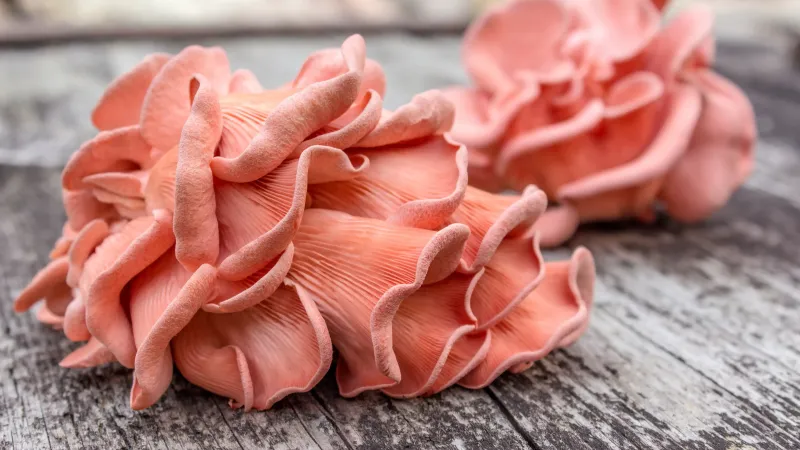
Pleurotus Djamor fruiting bodies
Scientific Classification
Kingdom:Fungi
Division:Basidiomycota
Class:Agaricomycetes
Order:Agaricales
Family:Pleurotaceae
Genus:Pleurotus
Frequently Asked Questions
- What is Pink Oyster?
- Pink Oyster (Pleurotus Djamor) is a mushroom species, belonging to the Pleurotaceae family. It is studied for its biological characteristics and is documented in the ShroomSpy mycology database.
- Is Pink Oyster edible?
- edible
- What is the scientific classification of Pink Oyster?
- Pink Oyster belongs to the kingdom Fungi, division Basidiomycota, class Agaricomycetes, order Agaricales, family Pleurotaceae, genus Pleurotus. Its scientific name is Pleurotus Djamor.
About
Pleurotus djamor, commonly known as the Pink Oyster mushroom, is a vibrant, tropical gourmet mushroom prized for its striking pink color, meaty texture, and mild seafood-like flavor. As one of the most visually captivating edible mushrooms, it is a favorite in culinary, permaculture, and urban farming circles, especially in warm climates and indoor grow operations.
History
Native to southeast Asia and tropical regions, Pleurotus djamor has long been consumed for its culinary value and is now cultivated worldwide thanks to its fast growth, aggressive colonization, and sustainability. It has gained fame in recent decades for its role in farm-to-table cuisine, mushroom kits, and community farming education due to its ease of cultivation and fast fruiting cycle.
Nutritionally, it is low in fat, rich in protein, fiber, potassium, and contains antioxidants and beta-glucans known to support immune function.
Overview
The fruiting bodies grow in dense, cascading clusters with bright pink caps, often fading to peach or cream when cooked. They have thin, delicate flesh and require quick cooking (sautéing or grilling) to preserve texture and flavor.
Medicinal studies suggest potential antioxidant, antitumor, and cholesterol-lowering properties. In environmental science, P. djamor is also studied for mycoremediation and plastic degradation potential.
Flavors
Mild
Pleurotus djamor has a mild, subtly sweet flavor with a hint of nuttiness.
Textures
Soft
Pleurotus djamor has a soft, delicate texture when cooked.
Fragrances
Gentle
Pleurotus djamor has a mild, pleasant aroma.
Physical Characteristics
Caps:
Small to medium-sized with a vibrant pink to salmon color
Gills:
N/A
Pharmacology
Helps With
Heart Health
Oyster mushrooms are also packed with fiber, which benefits your gut and overall health. The beta-glucans found in oyster mushrooms are linked to improving glucose, fat metabolism, and blood pressure. Additionally, oyster mushrooms contain mevinolin, which lowers cholesterol, reducing the risk of cardiovascular disease and other conditions.
Diabetes
Oyster mushrooms are also packed with fiber, which benefits your gut and overall health. The beta-glucans found in oyster mushrooms are linked to improving glucose, fat metabolism, and blood pressure. Additionally, oyster mushrooms contain mevinolin, which lowers cholesterol, reducing the risk of cardiovascular disease and other conditions.
Digestion
Oyster mushrooms are also packed with fiber, which benefits your gut and overall health. The beta-glucans found in oyster mushrooms are linked to improving glucose, fat metabolism, and blood pressure. Additionally, oyster mushrooms contain mevinolin, which lowers cholesterol, reducing the risk of cardiovascular disease and other conditions.
Pink Oyster Products
Explore Pink Oyster products from independent vendors
Chemical Constituents
Medicinal Chemistry
Similar Species
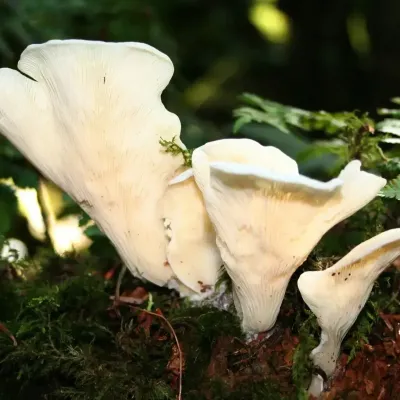
Species: Pleurocybella porrigens
(Angel's Wings)
Edibility: POISONOUS — do not eat. Pleurocybella porrigens (Angel's Wings) was long considered edible but is now known to cause delayed, sometimes fatal acute encephalopathy (brain damage). In 2004 at least 17 people in Japan died after eating it; every fatality had pre-existing kidney disease. It contains one or more toxins that remain chemically unidentified, and no amount of cooking is known to make it safe. People with impaired renal function are at greatest risk. It is easily confused with edible oyster mushrooms (Pleurotus ostreatus); a key distinction is that Angel's Wings grows on conifer wood while oysters grow on hardwoods. Avoid consumption entirely.
Key Differences: One mushroom that can be mistaken for the Pink Oyster (Pleurotus djamor) is the Angel Wing (Pleurocybella porrigens). Both mushrooms have a similar shape and can grow on wood, which can lead to confusion. The gills of Pink Oyster mushrooms are closely spaced and descend the stem. Angel Wing mushrooms also have decurrent gills, but they are more widely spaced
Species: Pleurocybella porrigens
(Angel's Wings)
Edibility: POISONOUS — do not eat. Pleurocybella porrigens (Angel's Wings) was long considered edible but is now known to cause delayed, sometimes fatal acute encephalopathy (brain damage). In 2004 at least 17 people in Japan died after eating it; every fatality had pre-existing kidney disease. It contains one or more toxins that remain chemically unidentified, and no amount of cooking is known to make it safe. People with impaired renal function are at greatest risk. It is easily confused with edible oyster mushrooms (Pleurotus ostreatus); a key distinction is that Angel's Wings grows on conifer wood while oysters grow on hardwoods. Avoid consumption entirely.
Key Differences: One mushroom that can be mistaken for the Pink Oyster (Pleurotus djamor) is the Angel Wing (Pleurocybella porrigens). Both mushrooms have a similar shape and can grow on wood, which can lead to confusion. The gills of Pink Oyster mushrooms are closely spaced and descend the stem. Angel Wing mushrooms also have decurrent gills, but they are more widely spaced
Nutrition Facts
Serving Size
Amount Per Serving
Calories
% Daily Value*
Total Fat 0.4 g1%
Saturated Fat 0 g0%
Trans Fat 0 g
Cholesterol 0 mg0%
Sodium 18 mg1%
Total Carbohydrate 6.1 g2%
Dietary Fiber 2.3 g8%
Total Sugars 1.1 g
Protein 3.3 g7%
Vitamin A 0 µg 0%•Thiamin B1 0.1 mg 8%
Riboflavin B2 0.3 mg 23%•Niacin B3 5 mg 31%
Vitamin B6 0.1 mg 6%•Folate B9 38 µg 10%
Vitamin B12 0 mg 0%•Vitamin C 0 mg 0%
Vitamin D 29 µg 145%•Vitamin E 0 mg 0%
Vitamin K 0 µg 0%•Calcium 3 mg 0%
Copper 0.2 mg 22%•Iron 1.3 mg 7%
Magnesium 18 mg 4%•Manganese 0.1 mg 4%
Phosphorus 120 mg 10%•Potassium 420 mg 9%
Selenium 2.6 µg 5%•Zinc 0.8 mg 7%
Vit A 0 µg 0%•B1 0.1 mg 8%
B2 0.3 mg 23%•B3 5 mg 31%
B6 0.1 mg 6%•B9 38 µg 10%
B12 0 mg 0%•Vit C 0 mg 0%
Vit D 29 µg 145%•Vit E 0 mg 0%
Vit K 0 µg 0%•Calcium 3 mg 0%
Copper 0.2 mg 22%•Iron 1.3 mg 7%
Mg 18 mg 4%•Mn 0.1 mg 4%
Phosph. 120 mg 10%•Pot. 420 mg 9%
Selenium 2.6 µg 5%•Zinc 0.8 mg 7%
* Percent Daily Values are based on a 2,000 calorie diet.
Mushroom Ratings
0.0
Based on 0 Reviews
5
★4
★3
★2
★1
★Share your thoughts
If you've consumed this mushroom, share your thoughts with our community
References
- Qutaibi, M. A. & Kagne , S. R. (2024). Exploring the Phytochemical Compositions, Antioxidant Activity, and Nutritional Potentials of Edible and Medicinal Mushrooms. .
- Loc, P. (2023). The relationship between mycelial growth and fruit body’s yield of oyster mushrooms (Pleurotus spp.) collected from southern Vietnam. .
- Hassan, A. A. (2023). Isolation, Phenotypic and Molecular Characterization of the Oyster Mushroom Pleurotus spp. and Evaluation of Its Efficacy in Producing the Antibiotic Pleurotin. .
- Sindhu, S. (2023). Oyster mushroom with short cropping duration and good taste developed through mono-monokaryon hybridization. .
- Sosa, E. M. (2023). Graded levels of dietary pink oyster mushroom, Pleurotus djamor meal, affects growth, feed efficiency, lipase activity and fiber content in final whole body of Nile tilapia fingerlings, Oreochromis niloticus. .
- Valdez-Solana, M. (2023). In Silico Characterization of the Physicochemical and Biological Properties of the Pink (Pleurotus djamor var. salmoneostramineus) Oyster Mushroom Chromoprotein. .
- Park, Y. (2021). Identification of the Antidepressant Function of the Edible Mushroom Pleurotus eryngii. .
- Kumari, S. (2021). Enhanced growth and yield of oyster mushroom by growth-promoting bacteria Glutamicibacter arilaitensis MRC119. .
- Urek, R. (2019). Production and partial characterization of the exopolysaccharide from Pleurotus sajor caju. .
- Taofiq, O. (2018). Mushroom-based cosmeceutical ingredients: Microencapsulation and in vitro release profile. .