Last updated:
Lentinula Edodes
"Shiitake, Oakwood"
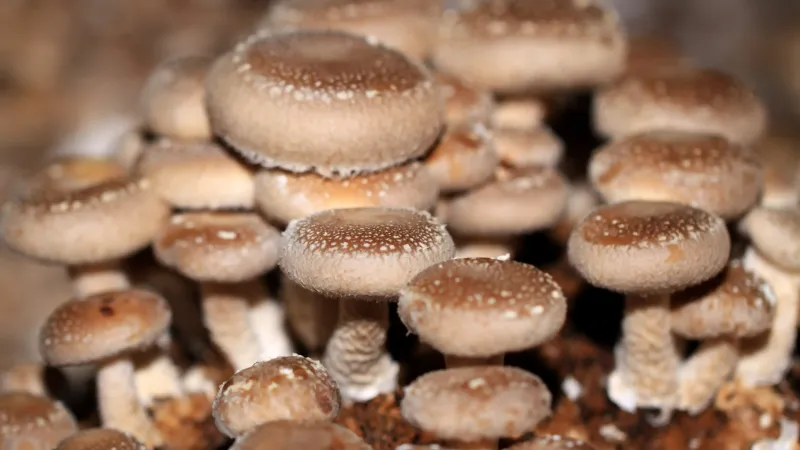
Lentinula Edodes fruiting bodies
Scientific Classification
Kingdom:Fungi
Division:Basidiomycota
Class:Agaricomycetes
Order:Agaricales
Family:Marasmiaceae
Genus:Lentinula
Frequently Asked Questions
- What is Shiitake?
- Shiitake (Lentinula Edodes) is a mushroom species, belonging to the Marasmiaceae family. It is studied for its biological characteristics and is documented in the ShroomSpy mycology database.
- Is Shiitake edible?
- edible
- What is the scientific classification of Shiitake?
- Shiitake belongs to the kingdom Fungi, division Basidiomycota, class Agaricomycetes, order Agaricales, family Marasmiaceae, genus Lentinula. Its scientific name is Lentinula Edodes.
About
Lentinula edodes, commonly known as Shiitake, is one of the most widely cultivated and consumed mushrooms globally, second only to Agaricus bisporus (button mushroom). Native to East Asia, it is prized not only for its rich, savory umami flavor but also for its well-documented health benefits. It has been used for centuries in traditional Asian medicine and cuisine and continues to play a central role in modern functional foods and nutraceuticals.
History
Shiitake mushrooms have been cultivated in China for over 1,000 years and are deeply integrated into Chinese and Japanese culture. The earliest records date back to the Song Dynasty, where it was used both as a food and medicine. In Japan, it was known as a “longevity mushroom” due to its reputation for promoting vitality and immunity.
Modern interest in Shiitake has expanded globally, particularly after the isolation of lentinan—a beta-glucan with immune-stimulating and potential anti-cancer properties. Shiitake cultivation has also become a model of sustainable agroforestry, often grown on oak logs or sawdust blocks.
Overview
Lentinula edodes features a brown, convex cap 5–10 cm wide, with white gills and a fibrous, sometimes scaly surface. The stem is tough and typically removed before cooking. It thrives on hardwood, especially oak, and can be found both in the wild and in commercial cultivation.
In the kitchen, Shiitake is known for its deep, meaty taste and is used in soups, stir-fries, broths, and vegan dishes. It contains key nutrients including B vitamins, copper, selenium, and polysaccharides like lentinan. Medicinally, it supports immune function, reduces inflammation, and has cholesterol-lowering and antiviral potential.
Flavors
Umami
Rich and savory flavor, often described as brothy or meaty
Textures
Chewy
A unique chewy texture when cooked
Fragrances
Earthy
A rich, earthy aroma
Physical Characteristics
Caps:
Convex cap with a wide range of colors from light brown to dark brown
Gills:
Off-white to cream-colored gills
Pharmacology
Helps With
Immune System
Shiitake mushrooms contain compounds that can enhance the immune system.
Heart Health
Certain compounds in shiitake mushrooms may promote heart health.
Oxidative Stress
Shiitake mushrooms are a good source of antioxidants that can help protect against oxidative stress.
Digestion
Shiitake mushrooms may have beneficial effects on the digestive system.
Arthritis
Shiitakes could directly reduce inflammatory symptoms caused by immune-related arthritis, and maitake mushrooms have immune-boosting properties.2 Medicinal mushroom extracts are packed with antioxidants that break down free radicals to help the body stay healthy.
Gut Microbiome
Shiitake mushrooms act as prebiotics, providing a food source for beneficial gut bacteria. This promotes a healthy balance in the gut microbiome, which is essential for proper digestion and immune function. Studies have shown that Shiitake mushrooms can enhance gut immunity and protect against pathogenic infections by supporting the growth of beneficial bacteria like Lactobacillus and Bifidobacterium.
Shiitake Products
Explore Shiitake products from independent vendors
Chemical Constituents
Medicinal Chemistry
Similar Species
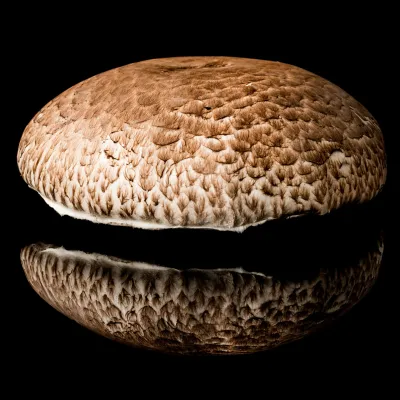
Key Differences: Agaricus bisporus has a more rounded cap and lacks the distinctive gill pattern of Lentinula Edodes.
Species: Agaricus Bisporus
(Portobello)
Edibility: edible
Key Differences: Agaricus bisporus has a more rounded cap and lacks the distinctive gill pattern of Lentinula Edodes.
Nutrition Facts
Serving Size100
Amount Per Serving
Calories34
% Daily Value*
Total Fat 0.5 g1%
Saturated Fat 0.1 g1%
Trans Fat 0 g
Cholesterol 0 mg0%
Sodium 9 mg0%
Total Carbohydrate 4.3 g2%
Dietary Fiber 2.5 g9%
Total Sugars 2.4 g
Protein 2.2 g4%
Vitamin A 0 µg 0%•Thiamin B1 0 mg 0%
Riboflavin B2 0.2 mg 15%•Niacin B3 3.9 mg 24%
Vitamin B6 0.3 mg 18%•Folate B9 13 µg 3%
Vitamin B12 0 mg 0%•Vitamin C 0.2 mg 0%
Vitamin D 0.45 µg 2%•Vitamin E 0 mg 0%
Vitamin K 0 µg 0%•Calcium 2 mg 0%
Copper 0.1 mg 11%•Iron 0.4 mg 2%
Magnesium 20 mg 5%•Manganese 0.2 mg 9%
Phosphorus 112 mg 9%•Potassium 304 mg 6%
Selenium 5.7 µg 10%•Zinc 1 mg 9%
Vit A 0 µg 0%•B1 0 mg 0%
B2 0.2 mg 15%•B3 3.9 mg 24%
B6 0.3 mg 18%•B9 13 µg 3%
B12 0 mg 0%•Vit C 0.2 mg 0%
Vit D 0.45 µg 2%•Vit E 0 mg 0%
Vit K 0 µg 0%•Calcium 2 mg 0%
Copper 0.1 mg 11%•Iron 0.4 mg 2%
Mg 20 mg 5%•Mn 0.2 mg 9%
Phosph. 112 mg 9%•Pot. 304 mg 6%
Selenium 5.7 µg 10%•Zinc 1 mg 9%
* Percent Daily Values are based on a 2,000 calorie diet.
Mushroom Ratings
0.0
Based on 0 Reviews
5
★4
★3
★2
★1
★Share your thoughts
If you've consumed this mushroom, share your thoughts with our community
References
- Qutaibi, M. A. & Kagne , S. R. (2024). Exploring the Phytochemical Compositions, Antioxidant Activity, and Nutritional Potentials of Edible and Medicinal Mushrooms. .
- Lindequist, U. (2024). Medicinal Mushrooms as Multicomponent Mixtures—Demonstrated with the Example of Lentinula edodes. Journal of Fungi.
- Kusaba, A. & Arai, T. (2024). Shiitake mushroom powder supplementation increase antioxidative activity in dogs. Frontiers in Veterinary Science.
- Uffelman, C. (2023). An Assessment of Mushroom Consumption on Cardiometabolic Disease Risk Factors and Morbidities in Humans: A Systematic Review. .
- Baptista, F. (2023). Nutraceutical Potential of Lentinula edodes’ Spent Mushroom Substrate: A Comprehensive Study on Phenolic Composition, Antioxidant Activity, and Antibacterial Effects. .
- Citores, L. (2023). Structural and functional characterization of the cytotoxic protein ledodin, an atypical ribosome‐inactivating protein from shiitake mushroom (Lentinula edodes). .
- Guo, Y. (2023). Two Strains of Lentinula edodes Differ in Their Transcriptional and Metabolic Patterns and Respond Differently to Thermostress. .
- Yamaguchi, Y. (2019). Efficacy and Safety of Orally Administered Lentinula edodes Mycelia Extract for Patients Undergoing Cancer Chemotherapy: A Pilot Study. .
- Wang, T. (2019). Mycelial polysaccharides of Lentinus edodes (shiitake mushroom) in submerged culture exert immunoenhancing effect on macrophage cells via MAPK pathway. .
- Cao, X. (2019). The protective effects of a novel polysaccharide from Lentinus edodes mycelia on islet beta (INS-1) cells damaged by glucose and its transportation mechanism with human serum albumin. .