Last updated:
Hypsizygus ulmarius
"Elm Oyster Mushroom, White Elm Mushroom"
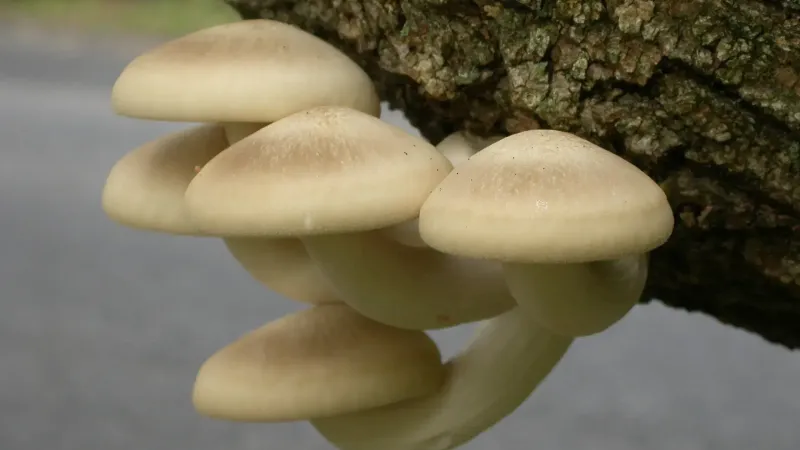
Hypsizygus ulmarius fruiting bodies
Scientific Classification
Kingdom:Fungi
Division:Basidiomycota
Class:Agaricomycetes
Order:Agaricales
Family:Lyophyllaceae
Genus:Hypsizygus
Frequently Asked Questions
- What is Elm Oyster Mushroom?
- Elm Oyster Mushroom (Hypsizygus ulmarius) is a mushroom species, belonging to the Lyophyllaceae family. It is studied for its biological characteristics and is documented in the ShroomSpy mycology database.
- Is Elm Oyster Mushroom edible?
- Edible - a choice edible mushroom, regarded by many experts as superior to common oyster mushrooms in flavor and firm texture. It is unrelated to true oysters (Pleurotus) despite a superficial resemblance.
- What effects does Elm Oyster Mushroom produce?
- Elm Oyster Mushroom is associated with the following effects: Focus, Energy. Individual experiences vary based on dose, set, and setting.
- What is the scientific classification of Elm Oyster Mushroom?
- Elm Oyster Mushroom belongs to the kingdom Fungi, division Basidiomycota, class Agaricomycetes, order Agaricales, family Lyophyllaceae, genus Hypsizygus. Its scientific name is Hypsizygus ulmarius.
About
Hypsizygus ulmarius, commonly called the elm oyster mushroom or white elm mushroom, is a saprophytic, brown-rot fungus that fruits on living and dead hardwoods, particularly elms, cottonwoods, beech, maple, and willow. Although its broad cap superficially resembles a true oyster mushroom, it is not closely related to Pleurotus; unique microscopic features and a brown-rot habit place it in the genus Hypsizygus. It is valued as a choice edible and is cultivated commercially, especially in Japan.
History
The taxonomy of this species has a long and confused history. It was originally described from Europe in the Bulliard: Fries tradition and was at various times treated as Pleurotus ulmarius (Bull.: Fr.) Kummer and Lyophyllum ulmarium (Bull.: Fr.) Kühner before Redhead transferred it to Hypsizygus ulmarius in 1984. The genus name comes from the Greek hypsi ("on high" or "aloft") and zygos ("yoke"), while the epithet ulmarius derives from the Latin ulmus, "elm," reflecting its frequent association with elm trees. In Japan it is known as shirotamogitake ("white elm mushroom") and tamo-motashi.
Overview
Ecologically, H. ulmarius is a brown-rot decomposer of hardwoods, in contrast to the white rot produced by Pleurotus ostreatus — a key feature distinguishing the two. The cap is hemispheric to plane (occasionally umbilicate), uniformly tan, beige, grayish brown to gray, 4-15 cm across, with an inrolled-to-incurved margin when young; the gills are decurrent and close, and the stem is thick, eccentrically attached, and curved at the base. Cultivated in Japan since 1973 on hardwood sawdust or logs, it is prized for a firm texture and mild, pleasant flavor. Reported medicinal interest (antitumor/immune-modulating properties) rests largely on anecdotal and unpublished reports and on data from close relatives, so such claims should be treated as preliminary.
Physical Characteristics
Caps:
The cap is convex to flat, measuring 5-15 cm in diameter, with a smooth, pale to light brown surface that may become slightly sticky when moist.
Gills:
Gills are decurrent, closely spaced, and white to cream in color, becoming slightly darker with age.
Cognitive Effects
Focus
Hypsizygus ulmarius contains ergothioneine, a powerful antioxidant amino acid that accumulates selectively in neural tissue and may protect cognitive function over time.
Energy
High B-vitamin content including riboflavin and niacin in H. ulmarius supports mitochondrial energy metabolism and may reduce fatigue.
Pharmacology
Helps With
Immune System
H. ulmarius polysaccharide fractions may enhance natural killer cell cytotoxicity and macrophage phagocytosis in murine immunostimulation assays.
Cholesterol
Elm oyster mushroom consumption may contribute to cholesterol reduction through lovastatin and beta-glucan content similar to other Pleurotaceae.
Oxidative Stress
Ergothioneine in H. ulmarius accumulates in erythrocytes and mitochondria, providing targeted protection against oxidative stress in metabolically active tissues.
Gut Microbiome
Dietary fiber fractions in H. ulmarius, including chitin and beta-glucans, may act as prebiotics supporting beneficial gut bacterial populations.
Possible Side Effects
Allergies
Rare occupational asthma from spore exposure during cultivation; dietary allergy is uncommon.
Chemical Constituents
Medicinal Chemistry
Nutrition Facts
Serving Size100
Amount Per Serving
Calories295
% Daily Value*
Total Fat 3 g4%
Saturated Fat 0.4 g2%
Trans Fat 0 g
Cholesterol 0 mg0%
Sodium 22 mg1%
Total Carbohydrate 50 g18%
Dietary Fiber 16 g57%
Total Sugars 0 g
Protein 24 g48%
Vitamin A 0 µg 0%•Thiamin B1 0 mg 0%
Riboflavin B2 3.2 mg 246%•Niacin B3 14.5 mg 91%
Vitamin B6 0 mg 0%•Folate B9 0 µg 0%
Vitamin B12 0 mg 0%•Vitamin C 0 mg 0%
Vitamin D 6 µg 30%•Vitamin E 0 mg 0%
Vitamin K 0 µg 0%•Calcium 0 mg 0%
Copper 1.2 mg 133%•Iron 0 mg 0%
Magnesium 0 mg 0%•Manganese 0 mg 0%
Phosphorus 370 mg 30%•Potassium 2000 mg 43%
Selenium 26 µg 47%•Zinc 5.2 mg 47%
Vit A 0 µg 0%•B1 0 mg 0%
B2 3.2 mg 246%•B3 14.5 mg 91%
B6 0 mg 0%•B9 0 µg 0%
B12 0 mg 0%•Vit C 0 mg 0%
Vit D 6 µg 30%•Vit E 0 mg 0%
Vit K 0 µg 0%•Calcium 0 mg 0%
Copper 1.2 mg 133%•Iron 0 mg 0%
Mg 0 mg 0%•Mn 0 mg 0%
Phosph. 370 mg 30%•Pot. 2000 mg 43%
Selenium 26 µg 47%•Zinc 5.2 mg 47%
* Percent Daily Values are based on a 2,000 calorie diet.
Mushroom Ratings
0.0
Based on 0 Reviews
5
★4
★3
★2
★1
★Share your thoughts
If you've consumed this mushroom, share your thoughts with our community