Last updated:
Flammulina Velutipes
"Enoki, Enokitake, Velvet Foot, Winter Mushroom"
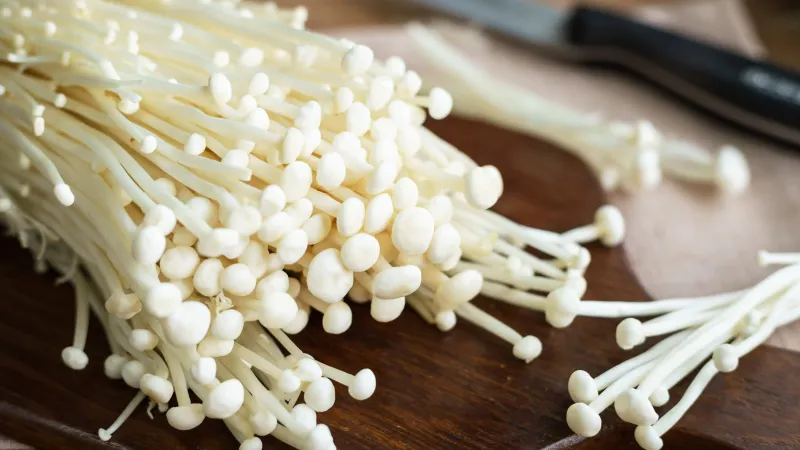
Flammulina Velutipes fruiting bodies
Scientific Classification
Kingdom:Fungi
Division:Basidiomycota
Class:Agaricomycetes
Order:Agaricales
Family:Physalacriaceae
Genus:Flammulina
Frequently Asked Questions
- What is Enoki?
- Enoki (Flammulina Velutipes) is a mushroom species, belonging to the Physalacriaceae family. It is studied for its biological characteristics and is documented in the ShroomSpy mycology database.
- Is Enoki edible?
- edible
- What is the scientific classification of Enoki?
- Enoki belongs to the kingdom Fungi, division Basidiomycota, class Agaricomycetes, order Agaricales, family Physalacriaceae, genus Flammulina. Its scientific name is Flammulina Velutipes.
About
Flammulina velutipes, commonly known as Enoki or Enokitake, is a long, slender, and delicate mushroom highly popular in East Asian cuisine. Known for its crisp texture and mild, slightly fruity flavor, Enoki is cultivated commercially in controlled, dark environments to produce its distinctive white, noodle-like appearance. In the wild, however, it appears as a golden to brown mushroom with a velvety stem, giving it the name "velvet foot."
History
Enoki has been consumed in Japan, China, and Korea for centuries, valued in traditional medicine for promoting liver function, immunity, and longevity. Cultivation began in earnest in the 20th century, with specialized methods developed to keep the mushrooms white, tender, and elongated—qualities favored in hotpots, soups, and salads.
Its wild form is much darker and hardier, growing on hardwood trees in cooler seasons. Enoki has also attracted scientific interest for its potential anti-cancer and immune-boosting polysaccharides, including flammulin.
Overview
Cultivated Enoki has long, thin white stems with tiny caps, typically sold in clusters. It is grown in low-light, high-CO₂ conditions to encourage vertical growth. In the wild, F. velutipes forms clusters of small, orange-brown mushrooms with velvety, dark-colored stems, often appearing in winter.
Enoki is low in calories, high in dietary fiber, antioxidants, B vitamins, and bioactive compounds. It is eaten cooked or lightly blanched, commonly added to ramen, nabemono, stir-fries, and rice dishes. Its texture holds well during cooking, making it a versatile ingredient in both traditional and fusion cuisine.
Flavors
Mild
Mild flavor with a hint of sweetness
Textures
Silky
Silky texture when cooked
Fragrances
Fungus
Typical mushroom aroma
Physical Characteristics
Caps:
Small, convex, becoming broadly convex to flat, slimy, orange-brown when fresh, fading to yellow-brown or buff
Gills:
Adnate to slightly decurrent, close, white to pale yellow
Enoki Products
Explore Enoki products from independent vendors
Chemical Constituents
Medicinal Chemistry
Similar Species
Key Differences: Galerina marginata has a more brownish cap and stem compared to the orange-brown cap and velvety black stem of Flammulina velutipes. Also, Galerina marginata is deadly poisonous while Flammulina velutipes is edible.
No image
Key Differences: Galerina marginata has a more brownish cap and stem compared to the orange-brown cap and velvety black stem of Flammulina velutipes. Also, Galerina marginata is deadly poisonous while Flammulina velutipes is edible.
Nutrition Facts
Serving Size
Amount Per Serving
Calories
% Daily Value*
Total Fat 0.3 g0%
Saturated Fat 0 g0%
Trans Fat 0 g
Cholesterol 0 mg0%
Sodium 3 mg0%
Total Carbohydrate 7.8 g3%
Dietary Fiber 2.7 g10%
Total Sugars 0.2 g
Protein 2.7 g5%
Vitamin A 0 µg 0%•Thiamin B1 0.2 mg 17%
Riboflavin B2 0.2 mg 15%•Niacin B3 7 mg 44%
Vitamin B6 0.1 mg 6%•Folate B9 48 µg 12%
Vitamin B12 0 mg 0%•Vitamin C 0 mg 0%
Vitamin D 5 µg 25%•Vitamin E 0 mg 0%
Vitamin K 0 µg 0%•Calcium 0 mg 0%
Copper 0.1 mg 11%•Iron 1.1 mg 6%
Magnesium 16 mg 4%•Manganese 0.1 mg 4%
Phosphorus 115 mg 9%•Potassium 359 mg 8%
Selenium 2.2 µg 4%•Zinc 0.7 mg 6%
Vit A 0 µg 0%•B1 0.2 mg 17%
B2 0.2 mg 15%•B3 7 mg 44%
B6 0.1 mg 6%•B9 48 µg 12%
B12 0 mg 0%•Vit C 0 mg 0%
Vit D 5 µg 25%•Vit E 0 mg 0%
Vit K 0 µg 0%•Calcium 0 mg 0%
Copper 0.1 mg 11%•Iron 1.1 mg 6%
Mg 16 mg 4%•Mn 0.1 mg 4%
Phosph. 115 mg 9%•Pot. 359 mg 8%
Selenium 2.2 µg 4%•Zinc 0.7 mg 6%
* Percent Daily Values are based on a 2,000 calorie diet.
Mushroom Ratings
4.0
(1)
Based on 1 Review
5
★4
★3
★2
★1
★Share your thoughts
If you've consumed this mushroom, share your thoughts with our community
01/29/2025
Zaky J
CalmContentEnergyHeadache
Finally tried Enoki mushrooms in a soup and they're actually really good. Crunchy texture with a mild flavor that doesn't overpower anything.
Felt more focused and calm after eating them which was unexpected. Like energized but not wired, you know? No jitters just... steady. Been adding them to meals regularly now - supposedly good for digestion and brain stuff and I can see why people say that.
Did get a mild headache the next day at first, maybe my body adjusting? Went away after a few times eating them. Now they're a regular thing in my kitchen. Easy to cook, taste good, actually seem healthy 👍
References
- Qutaibi, M. A. & Kagne , S. R. (2024). Exploring the Phytochemical Compositions, Antioxidant Activity, and Nutritional Potentials of Edible and Medicinal Mushrooms. .
- Jia, W. & Wang, W. (2024). Structural Elucidation of a Polysaccharide from Flammulina velutipes and Its Lipid-Lowering and Immunomodulation Activities. Polymers.
- Teo, Y. X. (2023). Fungus-derived protein particles as cell-adhesive matrices for cell-cultivated food. .
- Tsopmejio, I. S. (2023). Auricularia polytricha and Flammulina velutipes reduce liver injury in DSS-induced Inflammatory Bowel Disease by improving inflammation, oxidative stress, and apoptosis through the regulation of TLR4/NF-κB signaling pathways. .